
 (843) 361-7549
We Get Results*
If you were hurt because cargo shifted, spilled, or fell from a commercial truck, you may have a claim against a party responsible for loading, securing, inspecting, or transporting it.
A Myrtle Beach improperly loaded truck accident lawyer can investigate those roles, preserve cargo records, and pursue compensation for crash-related losses. Maguire Law Firm represents injury victims from its Myrtle Beach office.

Truck Accident Lawyer
Give us a call for a FREE & CONFIDENTIAL Case Review*

What Makes a Commercial Truck Load Dangerous?
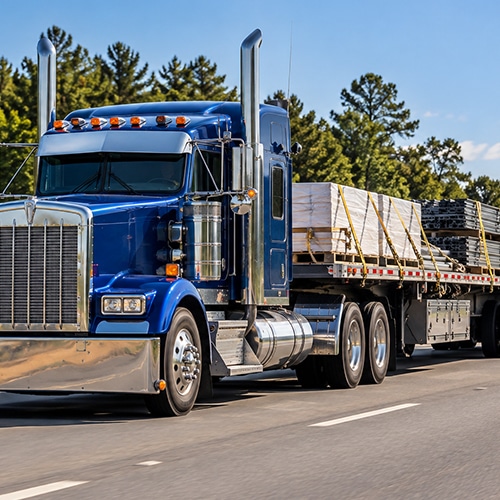 Although a commercial vehicle may not exceed the maximum gross weight allowable under federal regulations, there are many ways that a load can become unstable. A load may be unbalanced, items may be stacked without sufficient support, tie-down equipment may be insufficient to restrain cargo movement, or cargo may be positioned so that it can roll, slide, leak, or fall. If cargo shifts as the truck travels, it can lead to a rollover, jackknifing, or loss of directional control.
Under federal regulations, all covered commercial vehicles must be loaded in such a manner that no item of cargo may leak, spill, blow off, or fall from the vehicle; and cargo shall not shift during travel and thereby interfere with the vehicle’s stability and maneuverability. The regulations provide examples of acceptable methods to achieve these results, including: acceptable Vehicle configurations; dunnage; shoring bars; and tie down equipment.
In addition to federal regulatory requirements, South Carolina law prohibits the operation of a vehicle upon a public road where the load is not securely fastened in place to prevent escape or to create a hazardous condition. However, this statute includes several listed statutory exceptions. Additionally, South Carolina law imposes certain duties upon persons who load gravel and similar materials onto trucks.
| Load problem | Possible crash result | Useful evidence |
| Uneven distribution | Sway or rollover | Loading diagram and axle weights |
| Weak securement | Shifted or fallen cargo | Straps, chains, anchors, and photos |
| Excess weight | Poor braking or handling | Scale tickets and permits |
| Failed door, tarp, or tailgate | Road debris | Hardware, video, and inspection records |
Who May Have a Claim After a Cargo-Related Crash?
Drivers, passengers, motorcyclists, bicyclists, and pedestrians may have a claim when unsafe loading contributed to a collision and caused an injury. When a crash is fatal, South Carolina law permits a wrongful death action through the deceased person’s personal representative.
A viable claim generally requires evidence that a person or business failed to use reasonable care, that the failure helped cause the event, and that the victim suffered a compensable loss. A cargo rule violation may be important evidence, but the claim still requires a factual connection between the violation and the injury.
Related Article(s)
Myrtle Beach Truck Tire Blowout Accident Lawyer
Crashes Without Direct Cargo Contact
Cargo does not have to strike your vehicle for unsafe loading to cause harm. A shifting load may pull a trailer into another lane, cause a truck to roll, or force nearby drivers to take emergency action. Photos, witness accounts, vehicle data, cargo records, and reconstruction evidence may help distinguish a load-caused crash from cargo that moved only after impact.
Hurt in an Accident? Hire Maguire
Give us a call for a FREE & CONFIDENTIAL Case Review*Who Is Liable for Improper Loading?
Potential liability depends on each party’s conduct and legal responsibility for loading, securing, inspecting, maintaining, or transporting the cargo. Although the company whose name is listed on the truck may not be the one that owns the trailer; supplies the cargo; packs the cargo; or loads the cargo, contracts and shipping records are the best source of information about which parties are liable.
The Driver and Motor Carrier
For vehicles covered by federal rules, a driver may not operate, and a motor carrier may not require or permit operation unless the cargo is properly distributed and secured. The driver generally must inspect the cargo and securement devices within the first 50 miles, then recheck after a duty status change or after three hours or 150 miles, whichever comes first. The regulation contains an exception for a sealed vehicle the driver was ordered not to open and for cargo loaded in a way that makes inspection impracticable.
The carrier’s practices may matter as much as the driver’s actions. Relevant questions include whether the company supplied suitable equipment, trained the driver to inspect the load, responded to warnings, and allowed enough time for required checks.
Drivers may not operate their vehicles, nor can motor carriers require or allow them to do so, until they have checked and properly distributed secured cargo. Generally, drivers are required to check the cargo and the securing devices once during the first 50 miles of travel. Drivers of trucks and truck tractors generally must inspect the cargo and securement devices within the first 50 miles of a trip and reexamine them after a change in duty status, after three hours of driving, or after 150 miles, whichever occurs first. There is an exception under this regulation regarding a sealed vehicle that the driver has been instructed not to open, and where the cargo was loaded in such a manner that checking it would be unreasonable.
It may be just as important to examine the carrier’s practices as well as the driver’s actions. Questions to ask include: Does the carrier provide adequate equipment for loading? Has the carrier provided training to the driver to inspect the cargo? Did the carrier respond promptly to any warnings received about potential problems? Was sufficient time given to complete all inspections required under these regulations?
The Shipper or Loading Company
A shipper or warehouse company, or an independent trucker hired as a loading contractor, may have liability based upon their loading work creating some type of hazard. Facts important for establishing liability for this entity are: which party determined the placement of cargo and the method by which it would be secured? Was the trailer locked or sealed at the time the driver arrived? Were there any obvious defects on the trailer prior to the accident? What did the loader tell the driver about securing his load?
It is also very important that these distinctions exist due to federal guidelines regarding safe loading practices. Federal cargo-securement rules generally place responsibility on loading guidance to drivers/carriers; however, they do acknowledge certain practices carriers can implement if a shipper will be loading and sealing the trailer. Liability for the shipper or loader will depend on the specific evidence presented in the case along with the governing state laws. Thus, investigating the role of the shipper/loader vs assuming their role is recommended.
Equipment Owners and Manufacturers
A trailer owner, motor carrier, or maintenance contractor may be liable if negligent inspection, maintenance, or repair allowed a defective anchor point, door, latch, or other component to remain in service and that condition contributed to the crash or injury. Likewise, manufacturers may be liable if one of their products used in the securement system failed due to a design flaw or manufacturing defect. Claims against manufacturers/equipment owners for design/manufacturing defects will need to show that the product was defective and caused injury (i.e., damage) greater than just breaking during an accident.
Evidence That Can Show Why the Load Failed
Physical evidence involving the cargo, trailer, and securement systems can change quickly after a crash. Cargo may be removed, trailers repaired, and video or other electronic data may be overwritten or deleted under ordinary retention practices. Some federally required ELD records must be retained for at least six months, but other GPS, telematics, video, and loading records may have different retention periods. For that reason, an attorney may send preservation letters requesting that relevant physical evidence, records, video, and electronic data be preserved, arrange inspections of available evidence, and use formal discovery to obtain additional evidence if litigation is filed.
 Potential Sources of Information:
- The bill of lading, cargo manifest, load plan, and seal records
- Photographs, surveillance video, and employee records relating to loading operations
- Documentation showing weight, axle weights, permits, and route documents
- Driver inspection reports and records of cargo checks during the trip
- The trailer, doors, tarps, chains, straps, anchor points, blocks, and dunnage
- Dispatch messages, onboard camera footage, location data, and engine control data
- Police photographs, witness statements, and nearby business or traffic video
Bills of lading only show what was listed in writing; they don’t indicate how well the cargo was actually secured. As such, comparing a bill of lading to physical evidence (i.e., missing tie-downs, incorrect weight, open containers, broken seals) may be one way to determine if improper loading occurred.
Common Disputes in Improper Load Claims
The first dispute can relate to causation. You may need to prove that the improperly loaded or secured cargo caused or contributed to a crash, and thus caused your injuries. To do this, we’ll analyze how the load was positioned on the truck, whether it had moved prior to the incident, what happened during the crash, and how the parties acted throughout the time leading up to the crash. This includes looking into how well the load was inspected, and what the driver and/or the cargo owner said they did or didn’t see.
Also, it is not uncommon for carriers to raise issues regarding who controls the loading process. It may seem obvious; however, the way a load is secured, or not secured, may determine which party has responsibility. For example, if the cargo was loaded and sealed before the driver received the trailer, that fact may affect what the driver reasonably could inspect. Under 49 CFR §392.9, certain driver inspection requirements do not apply when the driver operates a sealed trailer and has been ordered not to open it, although the motor carrier still has responsibilities concerning proper loading and securement. On the flip side, if there were verbal assurances made by a representative of the company that hired the trailer driver that everything was secure, this may be relevant to determining which party is ultimately liable for your damages.
Another common response from a defendant after being sued due to a negligently loaded truck is to point out that your actions contributed to your injuries. South Carolina follows a modified form of comparative negligence. This means that if you were partially negligent (less than 50% at-fault), you may still receive compensation. The South Carolina Supreme Court explains this rule in its comparative negligence decision.
Damages Available Due to an Improperly Loaded Truck Crash
What types of losses are available? Depending on the injuries and losses you can prove were caused by the collision, recoverable damages may include:
- Past medical expenses
- Reasonably expected future medical expenses
- Rehabilitation/assistive equipment/medication/care needed to address your injury(s)
- Loss of income/wage earnings/due to time missed from work
- Decrease in ability to earn money in the future
- Damage to property (e.g., Vehicle repair costs & other damaged personal property)
- Physical pain & suffering
- Emotional distress
- Impairment
- Disfigurement
- Reduced quality of life
In South Carolina, the following are recognized as recoverable forms of personal injury damages: medical bills; lost earning capacity; physical pain & suffering; and disfigurement. Future damages must be supported by evidence showing that they are reasonably certain to occur and cannot be based on speculation or conjecture. Please refer to South Carolina court discussion of personal injury damages for further clarification.
Hurt in an Accident? Hire Maguire
Give us a call for a FREE & CONFIDENTIAL Case Review*How Long Do You Have to File a Lawsuit?
Generally speaking, under South Carolina statute of limitations, you have three years from the date of an injury to file an action against someone for causing you harm. Furthermore, South Carolina utilizes a “discovery” statute of limitations rule. Under this rule, you have three years from the date you knew, or through reasonable diligence should have known, that you have a viable claim. Therefore, in most cases the time limitation starts on the date of your accident. However, there are certain exceptions that may impact when the statute begins to run.
Government entities follow different procedures and timelines when considering claims. Typically, there is a two-year filing limit, although it may be extended to three years in limited circumstances when a valid claim was timely submitted. For additional guidance, please refer to the South Carolina Tort Claims Act. Waiting too long to file suit can result in missing opportunities. While waiting until close to the expiration date may appear prudent, time-sensitive items like cargo evidence may be gone long before then.
Steps to Take After a Suspected Load Failure
Your safety and medical needs always come first. When you can do so safely, the following steps can also be relevant:
- Call 911 and obtain medical care for possible injuries.
- Photograph the cargo, debris field, trailer, securement devices, vehicle positions, and road marks. Make sure not to enter an unsafe location to obtain these.
- Record the carrier name, United States Department of Transportation number, truck and trailer numbers, license plates, and witness contact information.
- Keep medical records, repair estimates, wage records, receipts, and photos of your injuries.
- Refrain from speculating about causes in recorded statements and avoid signing a final settlement agreement until you’re aware of the full extent of injury and all parties involved.
- Schedule an appointment with an attorney while evidence such as the truck, cargo, loading documents, and video evidence is still accessible.
How a Myrtle Beach Improperly Loaded Truck Accident Lawyer Can Help
A lawyer may investigate which people and companies may be legally responsible for the improper load, ask for preservation of the truck and its contents, obtain documentation of the truck and its contents loading and inspection process, examine possible violation(s) of regulations, seek consultation with specialized professionals/ experts to assist in determining why the cargo failed. Your lawyer would also assist in documenting your loss(es), defend against fault allegations made by defendant(s), assist with negotiation with defendant’s insurer(s) and, if necessary, file suit.
For information regarding whether an improperly loaded truck resulted in injuries to you, contact a Myrtle Beach improperly loaded truck accident lawyer at Maguire Law Firm. Please feel free to call us or fill out our online form so we can begin discussing your case for free and confidential. There is no attorney fee due unless we recover money for you. In addition to the attorney fee, clients are responsible for costs incurred in connection with representation; and the contingency fee is calculated as a percentage of the gross recovery before case expenses are deducted.