 (843) 361-7549
We Get Results*
If a commercial truck struck or squeezed you while turning, you may have a claim if an unsafe maneuver caused your injuries and losses. A Myrtle Beach wide turn truck accident lawyer can investigate the tractor and trailer’s path, the driver’s signals and observations, and the businesses involved. The fact that a truck needed extra space does not excuse a turn made without reasonable care.
Maguire Law Firm represents people injured in Myrtle Beach truck crashes. A prompt investigation matters because video, vehicle data, witness memories, and physical marks at the intersection can disappear long before the deadline for filing a lawsuit.

Truck Accident Lawyer
Give us a call for a FREE & CONFIDENTIAL Case Review*

Who May Have a Wide Turn Truck Accident Claim?
If you have injuries sustained due to a wide turn accident caused by another’s negligence, you may have a claim. In order to have a valid claim, there needs to be evidence that demonstrates the other party was negligent (failed to act reasonably) while the truck was turning; the negligence resulted in your injuries; and you experienced some type of damage. A variety of people could have a potential claim, including but not limited to: drivers, passengers, motorcyclists, bicyclists, pedestrians, and others.
If the collision results in the unfortunate death of one of the parties involved, under general principles of South Carolina law, the executor or administrator of the deceased will be required to pursue and settle the wrongful death claim. South Carolina’s wrongful death statutes determine which party(s) bring such a lawsuit and how settlements in wrongful death cases must be approved.
Related Article(s)
Myrtle Beach Fatigued Truck Driver Accident Lawyer
Myrtle Beach Truck Brake Failure Accident Lawyer
Why Large Trucks Need More Room to Turn
Large trucks are designed to operate at slower speeds than smaller vehicles. However, the design does cause them to take up additional space while navigating turns. During turns, the rear wheels of the large trailer follow a different path than the front wheels, and the larger the vehicle, the greater the rear tends to go off-path. Thus, in addition to being larger overall, they also “track” or move in addition to their parent tractor unit. For example, in a tight urban setting, a large truck may need significantly more space than a standard automobile to successfully navigate around curbs, islands, parked cars, bike lanes, and pedestrian areas.
The South Carolina Commercial Driver’s License Manual provides guidance to all CDL licensees regarding safe methods for completing turns. Specifically, it advises CDL licensees to turn slowly and to attempt to keep the rear of the trailer as close to the curb as possible during a right-hand turn. Additionally, CDL licensees are advised against swinging left prior to beginning a right-hand turn, as this may encourage motorists to drive past the tractor unit on the right side. Federal CDL regulations require operators to understand and properly demonstrate off-tracking maneuvers, and to position a commercial vehicle appropriately before and during turns, all during testing before they receive their CDLs.
Right Turns and the Trailer’s Path
A driver who moves left before turning right can create an apparent open lane beside the truck. If the signal is late, hidden, or unused, another road user may believe the truck is continuing straight or turning left. As the tractor turns right, the trailer can close that space.
It is common for a CDL holder to swing out left prior to initiating a right-hand turn. When this occurs, it creates an impression among other motorists that the entire length of the tractor unit will continue straight ahead rather than initiate a turn. At the time of initiation of the turn, the trailer closes the distance between itself and the surrounding traffic, creating a hazard for those nearby.
Left Turns and Intersection Clearance
As previously discussed, a truck making a left turn occupies the centerline of the intersection longer than most passenger automobiles. Furthermore, due to its larger width, it is necessary for the oversized vehicle to cross over another lane of traffic in order to reach its intended destination. The driver must select a sufficient gap in traffic, monitor his/her oversized vehicle, and ensure he/she yields to all other vehicles possessing the right-of-way. Safety of such actions is dependent upon proper placement within designated lanes, adequate activation of turn signals, appropriate positioning of both vehicles and intersections providing adequate sightlines, along with proper timing.
When Does a Wide Turn Become Negligent?
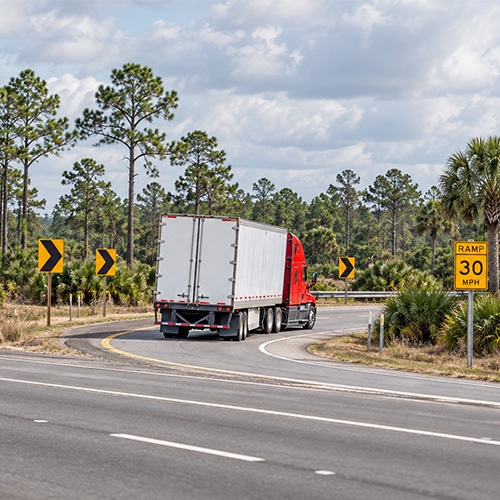 South Carolina law dictates that a driver making a right turn shall do so as close as practicable to the right-hand edge of the traveled portion of the highway. Additionally, South Carolina law states that no driver shall make a turn unless such can be done with reasonable safety and that all drivers shall indicate intent to turn by activating their turn signal for at least the last hundred feet of travel leading up to the point where the driver intends to begin executing said turn. Such requirements can be found in South Carolina’s turning position and signaling laws.
There are many examples of an unsafe turn, including but not limited to:
- starting a right turn too far from the curb,
- swinging left before checking for traffic approaching from the right,
- initiating a turn from a lane that is not assigned for such purpose,
- crossing marked pedestrian or bicycle paths without yielding,
- entering an intersection with insufficient clearance,
- failure to utilize mirrors and/or cameras installed on board.
While a traffic citation may provide evidence of negligence, it is still incumbent upon the injured party to demonstrate that the negligent actions of the driver proximately caused both the incident and resultant damages.
Who May Be Liable for the Crash Caused?
The Truck Driver
The driver may be liable for failing to activate turn signals, check mirrors, manage speed, yield to other vehicles, and properly position the vehicle prior to execution of a turn. Investigators should differentiate between a difficult but careful turn and one that ignores readily observable traffic conditions or basic commercial driving techniques.
The Motor Carrier or Other Business
An employer may be liable for acts performed negligently by employees acting within their employment capacity. Carriers may also incur liability for direct claims if their own selection and training procedures, supervisory practices, or decisions concerning whom to entrust with operating authority create unreasonable dangers. The South Carolina Supreme Court has recognized that such direct claims are legally distinct from liability for an employee’s misconduct.
The tractor unit, trailer unit, driver unit and freight/delivery unit may each be owned/controlled by different entities. Relevant contracts, dispatch records, registration information and insurance documentation may aid in determining which company controls the trip and/or driver.
Other Potentially Responsible Parties
Another motorist may contribute equally to any liability if that motorist created an emergency situation. Public entities may potentially be implicated if road conditions or traffic management decisions contributed to the accident. Claims against governmental entities follow unique procedural guidelines and timelines. Issues related to brakes, tires, steering systems, or cargo necessitate independent investigations.
Evidence That Can Reconstruct the Turn
 Due to the short duration of most turns (typically less than ten seconds), every detail matters. Some evidence related to recreating the events related to a wide turn includes:
- Photos or video taken after impact showing final vehicle positions relative to each other and/or lane markings; location of curb contact; locations of tires/trailer skid marks/debris; status of turn signals/sight obstructions.
- Patterns of damage indicating whether trailer swept into another vehicle or vice versa.
- Data related to GPS, telematic systems, dashcam footage, surveillance footage, etc., demonstrating movement/route/path traveled by the tractor unit.
- Testimony from witnesses regarding when turn signals were activated; location of each vehicle at time of accident; if tractor unit moved left before initiating right-hand turn.
- Documentation related to qualifications/drivers’ licenses/certifications; training records; vehicle specifications/mirror functionality/turn signal activation; onboard camera footage.
A police report can be valuable information; however, it might not provide the full details of a turning sequence. You may be able to receive a copy via the SCDMV collision report process. Preservation letters may need to be sent prior to erasing the electronic data. For example, federal regulations require motor carriers to retain drivers’ duty logs for at least six months and illustrate how long the time frame is limited and why you need to act quickly to preserve all the potential evidence.
Compensation Available After a Wide Turn Crash
A personal injury claim seeks compensation for losses caused by the collision. Depending on the evidence, recoverable damages may include ambulance and hospital charges, later medical care, rehabilitation, lost income, reduced earning ability, property damage, physical pain, emotional distress, scarring, disability, and loss of enjoyment of life. Future losses should be supported by medical opinions, employment records, and other reliable proof rather than estimates alone.
Punitive damages are not automatic. South Carolina permits them only when clear and convincing evidence shows that the harm resulted from willful, wanton, or reckless conduct. The requirements and statutory limits appear in South Carolina’s punitive damages statutes.
Claims for Personal Injury seek reimbursement for those losses resulting from a particular collision. Some examples of recoverable damages may be: ambulance and hospital services rendered immediately following the collision, subsequent medical services, rehabilitation, lost wages, diminished earning capacity, damaged/lost property, physical pain (past and/or future), emotional distress (past and/or future), scarring/disfigurement (permanent), disability (long-term/short term), and loss of enjoyment of life. All potential future losses should be based upon a medical professional’s opinion, employer documentation, etc., and not simply an estimate.
As to punitive damages in South Carolina, law permits punitive damages to be awarded only when there is clear and convincing evidence that the damages were the result of the defendant’s willful, wanton, or reckless conduct. Statutory limits on punitive damages are set forth in South Carolina’s punitive damages statutes.
Common Disputes in Wide Turn Claims
Insurance companies also commonly claim that the injured party could have avoided the collision. In South Carolina, under the State’s modified comparative negligence standard, an injured party who has contributed to his/her own injury and whose fault is 51% or more of the total fault cannot recover against either party. However, if the injured party’s fault is 50% or less of the total fault, he/she may still recover some amount of money for their losses, but the award will be reduced by the percentage of fault attributed to him/her. In order for an injured party to recover in a claim against an insurance company, they must demonstrate that their own fault was forty-nine percent or less of the total fault. The South Carolina Supreme Court discussed this comparative negligence rule in Clark v. Cantrell.
Additional disputes arise regarding whether the driver was employed at the time of the incident, whether there was one or multiple entities controlling the vehicle involved in the collision, whether the treatment provided by healthcare providers relates to the subject collision, and whether future losses are reasonably supported by credible evidence. Documentation and testimony can assist in resolving such controversies.
Steps to Take After a Turning Truck Collision
- Call 911, move out of active traffic if it is safe, and obtain medical care. Follow through with recommended treatment and describe every symptom accurately.
- If your condition allows, photograph the vehicles, company markings, plate, damage, road layout, signals, and surrounding businesses. Do not risk your safety to collect evidence.
- Obtain names and contact information from witnesses. Record your own recollection of the turn while it is fresh, including when you first saw a signal or noticed the trailer moving toward you.
- Keep medical bills, wage records, repair estimates, photographs, and correspondence. Avoid signing a release or giving a detailed recorded statement before you understand your injuries and the available coverage.
- Ask a lawyer about preserving evidence promptly, especially when the crash may have been recorded, or the tractor and trailer could be repaired, moved, or returned to service.
Hurt in an Accident? Hire Maguire
Give us a call for a FREE & CONFIDENTIAL Case Review*South Carolina Filing Deadlines
South Carolina provides a general three-year statute of limitation for bringing a lawsuit for personal injuries sustained in a motor vehicle accident. Similarly, South Carolina provides a three-year statute of limitation for actions seeking damages for wrongful death occurring as a result of a motor vehicle collision. View South Carolina’s general limitations statute for more details. There are exceptions to these general limitations periods; therefore, do not rely solely on the statute of limitations applicable to your claim when determining when to bring your claim.
When a tortfeasor is acting in the course and scope of her employment with the State of South Carolina or its political subdivisions at the time she causes an injury/damage to a plaintiff, then the plaintiff’s claim is subject to the South Carolina Tort Claims Act (“Tort Claims Act”). The Tort Claims Act establishes a two-year statute of limitations period for filing claims against governmental agencies/entities. Check the Act’s claim filing and limitations provisions. There can be exceptions to these limitation periods as they are general.
How a Myrtle Beach Wide Turn Truck Accident Lawyer Can Help
The lawyers at Maguire Law Firm assist clients with evaluating the potential for liability; investigating the cause of the wreck (and therefore whether the wide right turn was the sole cause of the wreck); identifying all potential defendants including carriers, drivers, and companies; sending out preservation notices; obtaining driver and company files, as well as conducting inspections on the vehicles involved.
Additionally, counsel will review the extent of your injury and evaluate whether there is potential liability and damages, as well as check your insurance coverage or other sources available for recovery. We will also review if multiple businesses are involved; the truck leaves the scene; the insurance company says you were at fault; or you’re unsure about how much insurance there is to cover your claim, then legal assistance could be valuable.
Talk With Maguire Law Firm About the Crash
Contact a Myrtle Beach-wide turn truck accident lawyer at Maguire Law Firm to discuss what happened and what evidence may still be available. Don’t hesitate to ask us any questions you may have. Call us or use our online contact form to request a free consultation.*
The firm’s Myrtle Beach office is at 1600 North Oak Street, Suite B, Myrtle Beach, South Carolina 29577.
Clients are responsible for costs in addition to attorney fees. Contingent fee percentages are calculated before costs are deducted. Every case is different, and past results do not guarantee a similar result or outcome.