
 (843) 361-7549
Motorcycles and cars share the same roads, but they do not share the same risk. The numbers from federal crash databases make the difference stark: riding a motorcycle is dramatically more dangerous per mile traveled than driving a passenger car, and understanding why requires looking beyond raw death counts to rates, crash scenarios, and the patterns of when and where crashes occur most often.
The Latest Motorcycle vs. Car Risk Gap
When comparing motorcycle and car crash risk, raw death counts can be misleading because there are far more passenger cars on the road, traveling far more miles collectively. A fairer comparison uses rates, deaths, or injuries per miles traveled, which adjust for exposure.
Related Article(s)
Motorcycle Safety Awareness Month Tips For Non-Riders
Myrtle Beach Bike Week: When Motorcycle Crashes Happen
Why rates matter more than raw counts
In 2023, NHTSA recorded 6,335 motorcyclist deaths compared with 23,959 passenger vehicle occupant deaths. At first glance, motorcyclists appear safer by raw count. But motorcycles represent a small fraction of total vehicle miles traveled in the United States. Once exposure is factored in, the fatality rate for motorcyclists was 31.39 per 100 million vehicle miles traveled, versus just 1.13 for passenger car occupants, a difference of more than 27 times.
| Metric | Motorcycles (2023) | Passenger Cars (2023) | Source |
|---|---|---|---|
| Deaths (total) | 6,335 killed | 23,959 killed | NHTSA CrashStats |
| Injuries (estimated) | ~82,564 | ~1,947,298 | NHTSA CrashStats |
| Fatality rate per 100M VMT | 31.39 | 1.13 | NHTSA / Press Release |
| Injury rate per 100M VMT | 409 | 88 | NHTSA CrashStats |
| Speeding in fatal crashes | 36% of riders | 22% of drivers | NHTSA CrashStats |
| Alcohol impairment in fatal crashes | 26% of riders killed | 24% of drivers | NHTSA CrashStats |
| Unprotected among fatalities | 34–35% not helmeted | 49% unrestrained | FARS / NHTSA seat belt data |
| Share of all traffic fatalities | 15% | Majority of remainder | NHTSA / IIHS |
Source: NHTSA CrashStats Motorcycles 2023 Data (Pub. 813732); NHTSA CrashStats Passenger Vehicles 2023 Data (Pub. 813723); NHTSA press release on motorcyclist VMT fatality rate
How Many Motorcycle Deaths Per Year
The short answer for the most recent available year: 6,335, according to NHTSA. IIHS also reports this figure and identifies it as the highest number ever recorded, with motorcycle deaths accounting for 15 percent of all motor vehicle crash deaths in 2023.
Looking at the trend over time shows that motorcyclist deaths fell during the mid-2010s before climbing again sharply during and after 2020.
| Year | Motorcyclists Killed | Notes |
|---|---|---|
| 2018 | 5,038 | Pre-pandemic baseline |
| 2019 | 5,044 | |
| 2020 | 5,620 | Pandemic-year increase |
| 2021 | 6,144 | Continued rise |
| 2022 | 6,251 | |
| 2023 | 6,335 | Highest ever recorded (IIHS) |
Source: NHTSA CrashStats Motorcycles 2023 Data fact sheet; IIHS fatality statistics for motorcycles and ATVs
The uptick beginning in 2020 tracks broadly with changes in traffic patterns during the pandemic, including faster speeds on emptier roads, followed by continued elevated risk. Behavioral factors, including speeding and alcohol impairment, remain consistently present in a significant share of fatal crashes each year.
On injuries: NHTSA estimates approximately 82,564 motorcyclists were injured in 2023. Unlike fatality counts, which come from FARS (a census of all fatal crashes), injury estimates come from the Crash Report Sampling System (CRSS), which samples police-reported crashes and extrapolates to national totals. Injury figures therefore, carry more statistical uncertainty than death counts.
How Do Many Motorcycle Crashes Happen
Understanding how motorcycle crashes happen is more useful when grounded in crash data than when reduced to a generic list of causes. Federal crash databases identify specific scenario distributions, behavioral factors, and exposure patterns that explain why and how crashes become fatal.
The most common fatal two-vehicle scenario: the left-turn crash
In 2023, NHTSA recorded 3,419 fatal two-vehicle crashes involving a motorcycle and another vehicle. In 46 percent of those crashes, the other vehicle was turning left while the motorcycle was going straight, passing, or overtaking. This single scenario, often called the left-turn crash, accounts for more fatal motorcycle crashes than any other two-vehicle configuration.
- A driver in the oncoming or crossing lane misjudges or fails to see an approaching motorcycle before turning
- Motorcycles’ smaller profile makes speed and distance harder for other drivers to judge
- This pattern occurs most often at intersections and driveway entrances
- Source: NHTSA CrashStats Motorcycles 2023 Data (Pub. 813732)
Behavioral and exposure factors that raise severity
Speeding: NHTSA reports that 36 percent of motorcycle riders involved in fatal crashes in 2023 were speeding, compared with 22 percent of passenger car drivers in fatal crashes. Higher speeds reduce reaction time and dramatically increase impact force, consequences that are especially severe for riders with no structural protection.
Alcohol impairment: NHTSA reports 26 percent of motorcycle riders killed in 2023 were alcohol impaired, slightly above the 24 percent share for passenger car drivers. Alcohol degrades the balance, coordination, and reaction time that are critical for motorcyclists.
Unlicensed riding: NHTSA reports that 34 percent of motorcycle riders in fatal crashes in 2023 were riding without a valid motorcycle license at the time, compared with 15 percent of passenger vehicle drivers lacking a valid license in fatal crashes. This licensing gap points to a training and certification shortfall that may significantly contribute to crash risk.
A research note on severe crash predictors
A peer-reviewed study analyzing Texas motorcycle crash data from 2017 through 2021 found that higher speed limits, poor illumination, darkness during weekends, and lack of helmet use were strong predictors of more severe motorcycle crashes. The study identified unsafe speed, driver inattention, lane departure, and failure to yield as leading contributing factors, findings that align with NHTSA’s national FARS patterns.
Motorcycle Crashes Happen Mostly Around Where and When
Many people assume motorcycle crashes happen mostly around intersections and curves, a phrase from motorcycle safety course materials. The national crash data offers a more nuanced picture: intersections are a meaningful risk area, but the majority of fatal crashes occur outside of them, and time-of-day patterns show a clear concentration in evening and weekend hours.
Time of day: late afternoon and early evening carries the highest risk
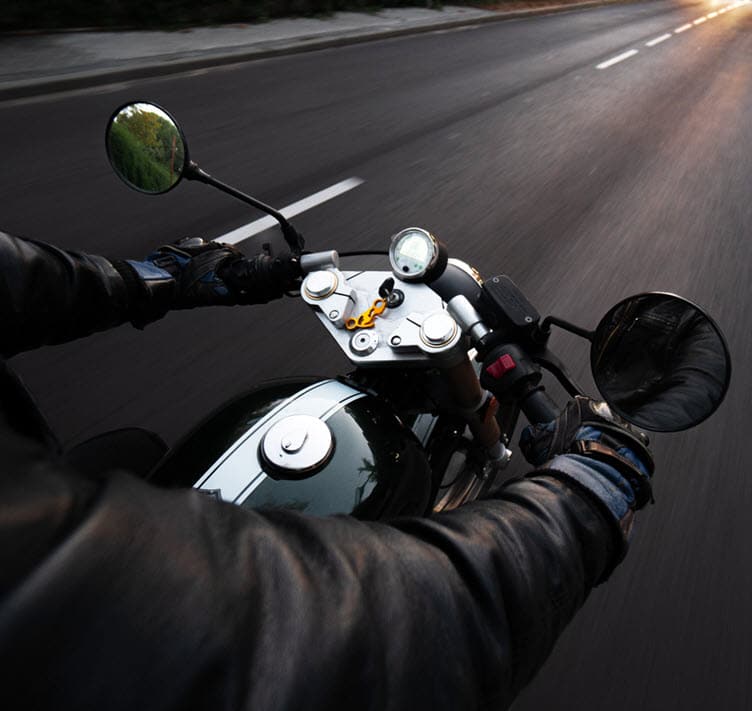
FARS tables for 2023 show the highest concentrations of motorcyclist fatalities in the late afternoon and early evening. The 6 p.m. to 8:59 p.m. window accounted for 1,444 motorcyclist deaths, 22.8 percent of the full-year total. The 3 p.m. to 5:59 p.m. window added another 1,327 deaths, or 20.9 percent. Together, these two windows represent more than 43 percent of all motorcyclist fatalities in just six hours of the day.
| Time Block | Motorcyclists Killed | Share of Total |
|---|---|---|
| 3:00 PM – 5:59 PM | 1,327 | 20.9% |
| 6:00 PM – 8:59 PM | 1,444 | 22.8% |
| Combined 3 PM – 9 PM | 2,771 | 43.7% |
| Weekend total (all hours) | 2,958 | 46.7% |
| Weekday total (all hours) | 3,371 | 53.3% |
Source: NHTSA FARS Encyclopedia — motorcyclist fatalities by time of day, 2023
The weekend versus weekday split, roughly 47 percent of deaths on weekends despite weekends covering only about 29 percent of the week’s hours, reflects the concentration of recreational riding during those periods.
Intersections versus non-intersection roads
NHTSA reports that 37 percent of motorcyclist fatalities in 2023 occurred at intersections, meaning 63 percent did not. While intersections are a meaningful risk point (and the left-turn scenario is heavily intersection-related), the majority of fatal motorcycle crashes occur on open roads, curves, and other non-intersection locations. Maintaining appropriate speed and attention everywhere, not just at intersections, is critical.
Urban versus rural
NHTSA reports that 65 percent of motorcyclist fatalities in 2023 occurred in urban areas and 35 percent in rural areas. This urban skew is consistent with where most miles are ridden and where intersection-related crashes concentrate. By contrast, passenger vehicle occupant fatalities have a higher rural share; NHTSA’s passenger vehicle fact sheet notes that rural areas accounted for 49 percent of passenger vehicle occupant fatalities.
State data can differ. SafeTREC’s 2023 facts page summarizing California motorcycle crash data for 2021 found that urban crashes accounted for 74 percent of fatal motorcycle crashes in that state, and that 40.4 percent of fatal motorcycle crashes occurred on Saturdays and Sundays, consistent with the national weekend pattern.
Why Motorcycles Are More Dangerous Than Cars in Crashes
The core physical difference is structural protection. A passenger car surrounds occupants with a steel cage, crumple zones, airbags, and seatbelts. A motorcycle provides none of these. When a crash occurs, a rider absorbs far more of the impact energy with no restraint system to limit movement.
Helmet use versus seat belt use among fatalities
NHTSA reports that 35 percent of the 6,335 motorcyclists killed in 2023 were not helmeted, based on known helmet use. FARS tables show a similar figure: 34.1 percent not helmeted, 62.3 percent helmeted.
Among passenger vehicle occupants killed in 2023, NHTSA reports that 49 percent were unrestrained. While the unrestrained share is higher for car fatalities, the base risk per mile for car occupants is already dramatically lower.
The CDC synthesizes the research evidence and concludes that motorcycle helmets reduce both death risk and head injury risk. Helmet effectiveness is one of the clearest and most consistently supported interventions in motorcycle safety.
| Protection Factor | Motorcycles | Passenger Cars |
|---|---|---|
| Primary protection type | Helmet (head only) | Full cage + airbags + seatbelt |
| % unprotected among fatalities (2023) | 34–35% not helmeted | 49% unrestrained |
| Evidence base | CDC: helmets reduce death and head injury risk | Seatbelts reduce fatality risk substantially |
Source: FARS tables 2023; NHTSA seat belt safety data; CDC motorcycle safety summary
How to Reduce Motorcycle Crash Risk
The data patterns above point directly to the interventions that safety research and agencies identify as most effective.
Helmet use and helmet laws
Wearing a helmet is the single most consistently supported protective behavior in motorcycle crash data. NHTSA notes that states with universal helmet laws have higher helmet use rates. Helmets meeting DOT standards (Federal Motor Vehicle Safety Standard No. 218) provide measurably higher protection than non-compliant or novelty helmets.
Licensing and formal training
The 34 percent unlicensed share of fatal motorcycle crashes suggests a substantial training deficit. Completing a state-approved motorcycle safety course, such as those offered through the Motorcycle Safety Foundation (MSF), builds the braking, cornering, and hazard-response skills that reduce crash risk, particularly for newer riders.
Sober riding and speed management
With 26 percent of motorcyclists killed being alcohol impaired and 36 percent speeding, sobriety and speed discipline are among the highest-leverage behavioral factors. Riding within the speed limit and within one’s own skill level, especially in low-visibility conditions and on unfamiliar roads, directly addresses the two largest behavioral contributors to fatal crashes.
Conspicuity and left-turn awareness
The left-turn crash scenario is partly a conspicuity problem. Wearing high-visibility gear, using headlights (required by law in most states), and riding in lane positions that keep the motorcycle visible to turning drivers can reduce exposure. Riders should approach intersections covering the brakes, at a speed that allows a quick stop if a driver begins turning unexpectedly.
Riding appropriate to conditions
The time-of-day data showing peak fatalities between 3 p.m. and 9 p.m., especially during dusk, underscores the value of adjusting riding behavior for diminished visibility. Reduced following distances, lower speeds, and enhanced roadway attention are appropriate for evening riding.
Frequently Asked Questions
How many motorcycle crashes happen?
Many motorcycle crashes happen when another vehicle violates the motorcyclist’s right of way, most commonly in two-vehicle crashes where the other vehicle turns left across the rider’s path. In fatal two-vehicle crashes involving a motorcycle and another vehicle, NHTSA reports that the other vehicle turning left appears in 46 percent of cases. Additional major contributors include speeding (36% of riders in fatal crashes), alcohol impairment (26%), and riding without a valid motorcycle license (34%).
Source: NHTSA CrashStats Motorcycles 2023 Data (Pub. 813732)
How many motorcycle deaths per year are there in the United States?
In 2023, the most recent finalized year, NHTSA reports 6,335 motorcyclists were killed in traffic crashes. IIHS identifies this as the highest annual total ever recorded. The count has risen from 5,038 in 2018.
Source: NHTSA road safety overview; IIHS fatality statistics for motorcycles and ATVs
Are motorcycles more dangerous than cars per mile traveled?
Yes. NHTSA reports 31.39 motorcyclist fatalities per 100 million vehicle miles traveled in 2023, compared with 1.13 for passenger car occupants, a difference of more than 27 times. The injury rate gap is similar: 409 vs. 88 per 100M VMT.
Source: NHTSA press release — Motorcycle Safety Awareness Month motorcyclist fatality rate
Motorcycle crashes happen mostly around what time of day?
National fatality data show the highest shares of motorcyclist deaths in late afternoon and early evening. In 2023, the 6 p.m. to 8:59 p.m. window accounted for 22.8 percent of all motorcyclist deaths, and the 3 p.m. to 5:59 p.m. window accounted for another 20.9 percent, totaling 43.7 percent in just six hours.
Source: NHTSA FARS Encyclopedia — motorcyclist fatalities by time of day, 2023
Motorcycle crashes happen mostly around intersections and curves, is that accurate?
Intersections are a significant risk area, but most fatal motorcyclist crashes occur outside intersections. NHTSA reports 37 percent of motorcyclist fatalities occurred at intersections in 2023, meaning 63 percent did not. The “intersections and curves” answer comes from motorcycle safety course materials, not from national crash distribution data.
Source: NHTSA CrashStats Motorcycles 2023 Data (Pub. 813732)
What percent of motorcyclists killed were not wearing a helmet?
NHTSA reports that 35 percent of motorcyclists killed in 2023 were not helmeted, based on known helmet use. FARS tables show 34.1 percent coded as not using a helmet, with 62.3 percent coded as helmeted.
Source: NHTSA CrashStats; FARS motorcyclist tables, 2023
How many motorcyclists are injured each year?
NHTSA estimates approximately 82,564 motorcyclists were injured in 2023, based on national sampling from the Crash Report Sampling System (CRSS). Injury figures carry more statistical uncertainty than the fatality count because they rely on sampling rather than a full census.
Source: NHTSA CrashStats Motorcycles 2023 Data (Pub. 813732)
What is the most common fatal two-vehicle motorcycle crash scenario?
In fatal two-vehicle crashes involving a motorcycle and another vehicle, NHTSA reports the other vehicle turning left while the motorcycle goes straight, passes, or overtakes occurs in 46 percent of cases. This left-turn scenario is the single most common configuration in fatal two-vehicle motorcycle crashes in 2023.
Source: NHTSA CrashStats Motorcycles 2023 Data (Pub. 813732)
Sources and Primary Data
All statistics in this guide are drawn from primary federal datasets and widely cited research summaries.
- NHTSA CrashStats fact sheet: Motorcycles 2023 Data — crashstats.nhtsa.dot.gov (Pub. 813732)
- NHTSA CrashStats fact sheet: Passenger Vehicles 2023 Data — crashstats.nhtsa.dot.gov (Pub. 813723)
- NHTSA road safety overview for motorcycles — nhtsa.gov/road-safety/motorcycles
- NHTSA press release: Motorcycle Safety Awareness Month/motorcyclist fatality rate per VMT — nhtsa.gov
- NHTSA FARS Encyclopedia — motorcyclist fatalities by time of day and helmet use — fars.nhtsa.dot.gov
- IIHS fatality statistics: Motorcycles and ATVs — iihs.org
- CDC motorcycle safety and helmet effectiveness summary — cdc.gov
- National Safety Council Injury Facts: Motorcycles — injuryfacts.nsc.org
- SafeTREC 2023 motorcycle safety facts (California 2021 data) — safetrec.berkeley.edu
- Peer-reviewed study: motorcycle crash severity predictors, Texas 2017–2021 — MDPI Sustainability (doi:10.3390/su15131037)
Last updated Thursday, March 26th, 2026

 (843) 361-7549